
2020 Best in Tonalism Online Juried Showcase
The 2020 Best in Tonalism Online Juried Showcase will open on July 15. Paintings will be available for sale through the website.

The results are in!
The 2020 Best in Tonalism Online Juried Showcase will open on July 15. Paintings will be available for sale through the website. The last day to purchase paintings is August 15.
What is Tonalism? Part I
Editors Note: This article is reprinted courtesy of guest author, Deborah Paris.In the decade following the Civil War, America came to terms with its great loss–both of a generation of young men, and the feeling of high spirited nationalistic pride and belief in...
Editors Note: This article is reprinted courtesy of guest author, Deborah Paris.
In the decade following the Civil War, America came to terms with its great loss–both of a generation of young men, and the feeling of high spirited nationalistic pride and belief in itself as the chosen land and the chosen people of God’s creation. The societal underpinnings of religious faith were likewise shaken. The operatic creations of Hudson River School artists like Church, Cole, Bierstadt and Moran seemed completely out of touch with a more subdued and melancholy national zeitgeist. A quiet more reflective art was more appropriate to the public mood.
As a result, by the 1880’s nothing short of a revolution had occurred in American landscape painting. The large panoramic views and detailed foregrounds of the Hudson River School were replaced by the suggestive, atmospheric and intimate landscapes of the Tonalist artists. The first generation of Tonalist artists like George Inness had begun painting in the prevalent Hudson River School style at the beginning of their careers, but pioneered a new poetic, spiritual, and personal style of landscape painting. These evocative landscapes struck an elegiac chord, often depicting transitional times of day and autumnal seasons.

Georgia Sunset- George Inness
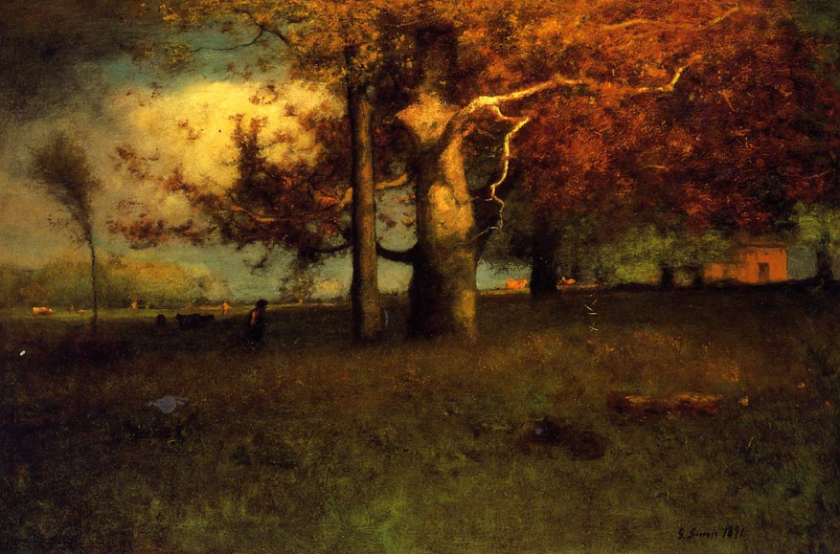
Autumn Montclair- George Inness
The first generation of Tonalist artists, born between 1840 and 1865, were shaped by American experience and culture. In the writings of Ralph Waldo Emerson and Henry David Thoreau, Americans found a different way of responding to nature and a more mystical spirituality. No two authors were more widely read and had a greater influence on late 19th century American thought and culture–an influence that lasts to this day.
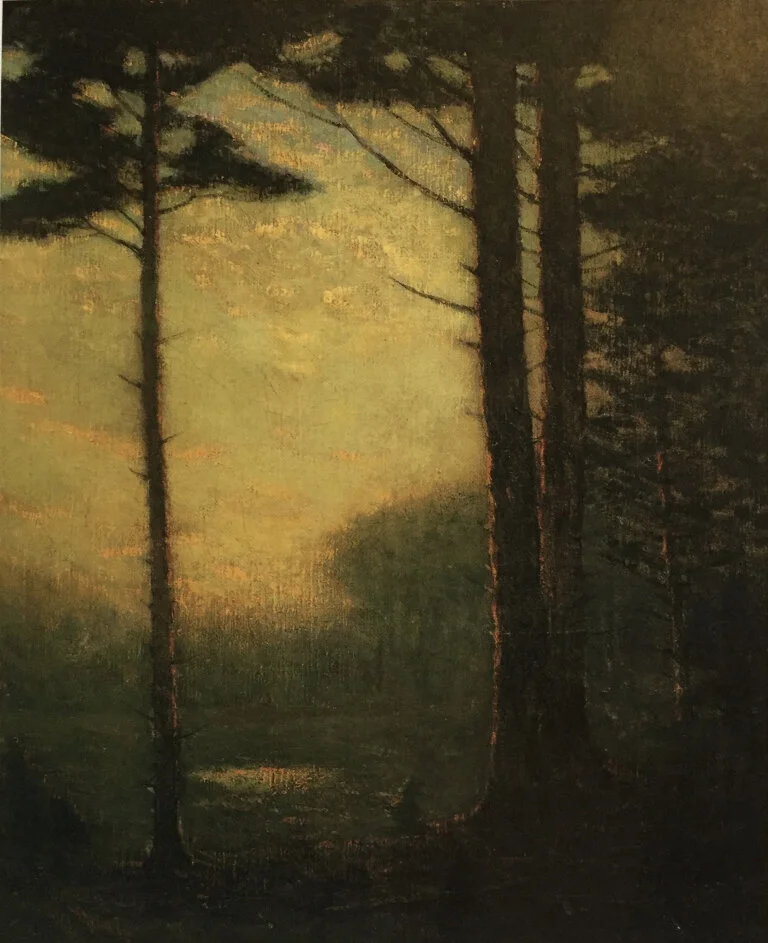
Sunset Pines- Charles Warren Eaton

Autumn Twilight- Charles Warren Eaton
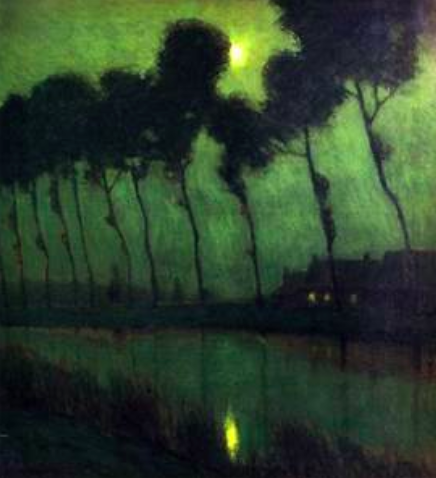
Poplars- Charles Warren Eaton
Emerson (1803-1882) first set forth his philosophy of Transcendentalism in the 1836 essay Nature. Emerson espoused that nature was an emblem or symbol, and its relevance lay in the insights it provided into the human mind and spirit. As a mentor and friend to Thoreau, Emerson asked the young Thoreau “do you keep a journal?”, an inquiry which spurred the perhaps most prolific journal writer in American literature.
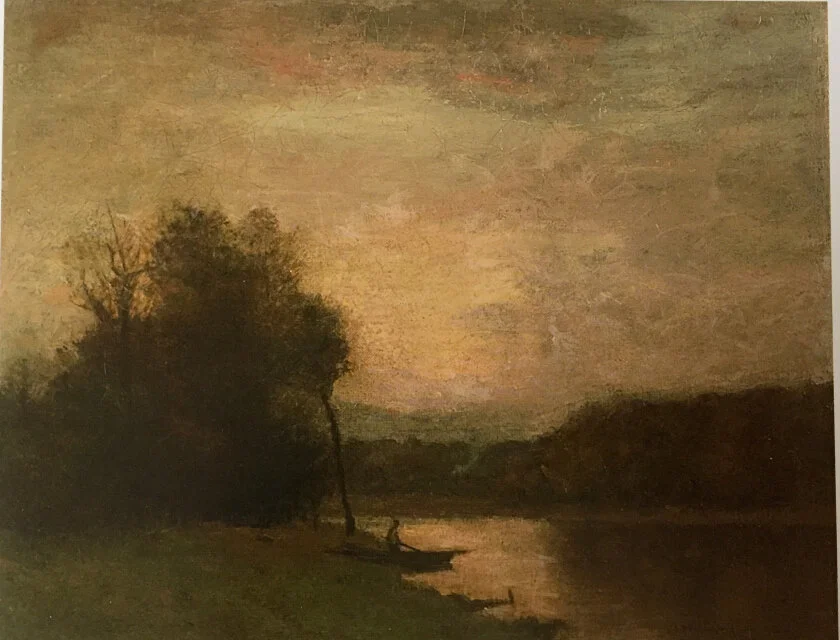
J. Francis Murphy
Thoreau (1817-1862) although a fellow Transcendentalist, was cut from a very different cloth. Emerson was full of Romantic subjectivity, using brilliantly insightful generalizations and intuitive leaps about the realm of the spirit. Thoreau was a wanderer, a nature writer, and a keen almost obsessive observer of the natural world. As a result, his more empirical approach was the platform from which he drew insights into the human soul. For Thoreau, nature was reality, important for its own sake as well as for symbolic purposes. But for both Emerson and Thoreau, the meeting of the material and the spiritual world in a transcendent experience was the goal and a possibility for every human being.
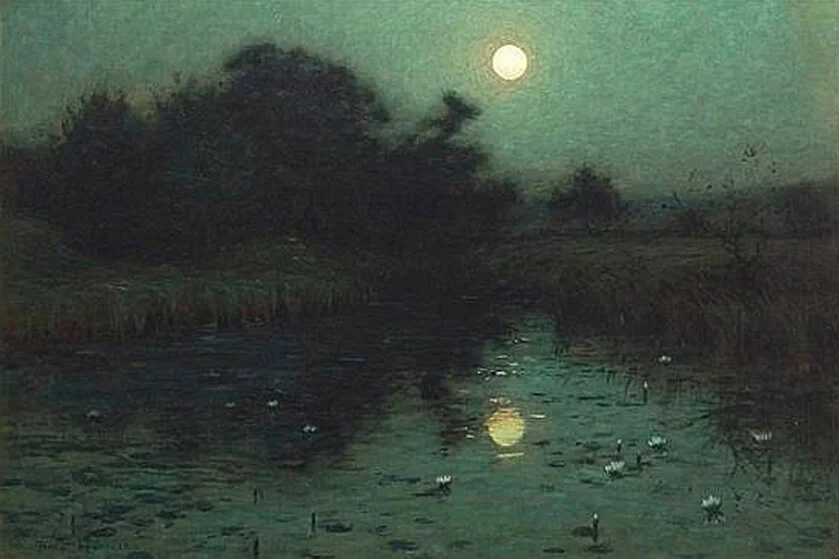
Birge Harrison
Nature was no longer simply the Hudson River School’s symbol or evidence of God’s presence in the world, but instead was itself the conduit through which this transcendent state might occur. For Thoreau particularly, the act of perception of Nature was the first step toward a “mystical unity of the observer and the observed”.
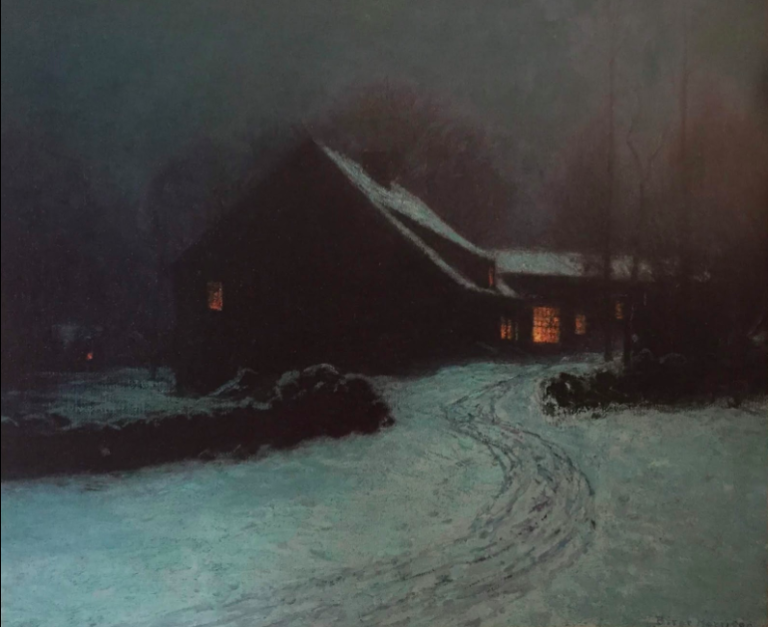
Birge Harrison
Emerson lectured widely in his later years and his ideas began to catch the public imagination especially after the Civil War. Although Thoreau died in 1862, his work was not widely read in America until the 1880s. His combination of transcendental philosophy, non-sectarian spiritualism, and dedication to the idea of correspondence between man and nature, made him a perfect prophet for the Tonalist revolution. His nature descriptions were praised by the subsequent Tonalist generation of artists. Dwight Tryon called Thoreau “the best landscape word painter”.
Today, the Tonalist style of landscape painting has reemerged as a contemporary movement. The philosophical and spiritual underpinnings of the original Tonalist movement, and its emphasis on a personal relationship with nature, makes this style particularly appealing to the contemporary landscape painter and an apt reflection of our times. The landmark publication of David Cleveland’s History of American Tonalism in 2010 introduced a whole new generation of artists and collectors to the Tonalist aesthetic. The growing interest in this style of painting is reflected in the recent formation of the American Tonalist Society and its inaugural exhibition at the historic Salmagundi Club in New York, an institution with deep ties to the original Tonalist movement.
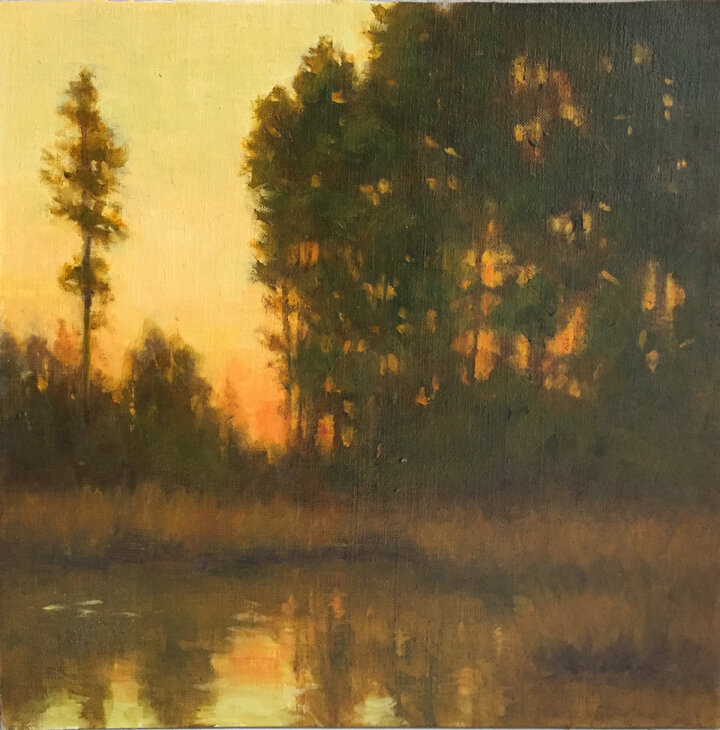
Pineywoods Evening- Deborah Paris
In Part II of this post, we’ll take a look at the contemporary landscape painters who have adopted the Tonalist aesthetic and how their works both reflect the historic roots of Tonalism and represent a leading edge of contemporary landscape painting.
P.S. Our six week online class Painting the Luminous Landscape is an introduction to the Tonalist style and to indirect painting techniques. It starts June 21st. Join us!
Show Preview | American Tonalist Society – Southwest Art Magazine
This story was featured in the May 2019 issue of Southwest Art magazine.
New York, NY Salmagundi Club, May 3-10
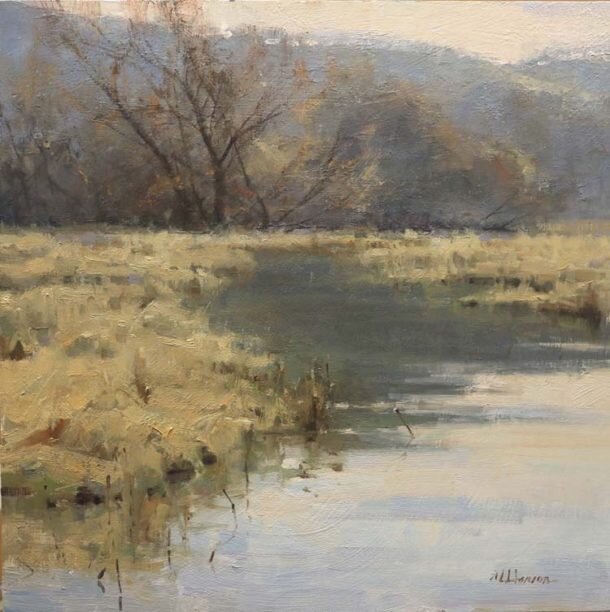
Marc Hanson, Spring Silence, oil, 18 x 18.
WHEN FOUR EAST Coast artists founded the American Tonalist Society in 2016, their objective was simple: launch a fine-art exhibition dedicated to showcasing exemplary works created in the tonalist tradition. The 19th-century art movement, which waned considerably as modernism took hold in the 20th century, has experienced a revival in recent years, notes landscape artist and ATS cofounder Eleinne Basa. “We do feel there’s a resurgence in doing these quiet paintings of the landscape that express mood and emotion,” she says. “We saw that and said we should form a show, and the next logical step was to create a group.”
Titled after the neutral colors and limited values that characterize tonalism, the society’s inaugural exhibition and sale—Shades of Gray—opens on Friday, May 3, at the Salmagundi Club in New York City. Founded in 1871, the historic fine-arts center is a fitting venue for the group’s first show, notes Basa. “A large group of 19th-century tonalists would meet at the Salmagundi Club,” she says. “George Inness, J. Francis Murphy, all these famous tonalists would hang their work there.”
Following in the footsteps of their artistic forebears, more than two dozen nationally recognized painters contribute several works each to the debut exhibition, including Basa and ATS cofounders Daniel Ambrose, Donald Demers, and Mary Erickson. They share the walls with Brent Cotton, Douglas Fryer, Marc Hanson, Charlie Hunter, David Sharpe, Karen Vance, and 12 other marquee names who have been inducted as the group’s first Signature members. “We have a good mix of artists from the East and West, so landscape-wise, we have a variety,” says Basa. “Of course, tonalism can appear in other contemporary genres,” she adds. “A city scene can be tonalist, and a still life can have a tonalist feel to it.” Naturally, tonalism can be applied to animal subjects, as well. Conservationist Mary Erickson, for example, showcases a portrait of a bird in varying shades of white.
Basa emphasizes that not everyone taking part in the show paints exclusively tonalist works, but all of the artists were invited to participate because at least some of their works pay homage to tonalism in a traditional or contemporary way. “The gist of tonalism is to awaken an emotion, so that’s what we all agree upon,” she says. “Tonalism is not about portraying all these little details. It’s about the emotion a painting brings to the viewer.” —Kim Agricola
Contact information: www.americantonalistsociety.com
This story was featured in the May 2019 issue of Southwest Art magazine.
Egg Tempera Artist’s Exhibition Features Two from Series
Eight for a Wish, egg tempera, 24 x 36 in. Florida artist Daniel Ambrose’s egg tempera paintings will be exhibited at the Hughes Gallery in Boca Grande, Florida, through May 2019. Two ‘Meet the Artist’ events were scheduled, one in mid-January and one in...
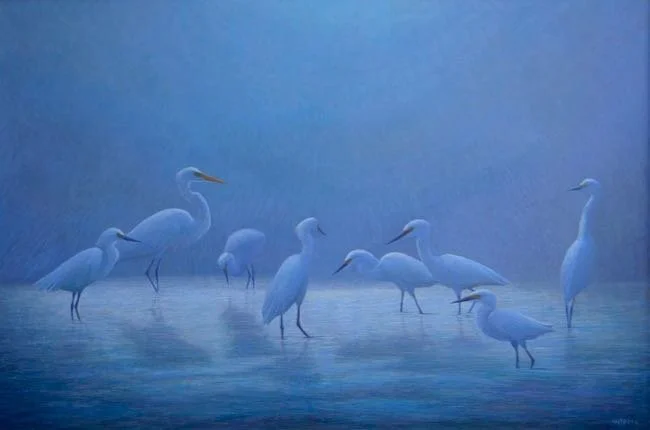
Eight for a Wish, egg tempera, 24 x 36 in.
Florida artist Daniel Ambrose’s egg tempera paintings will be exhibited at the Hughes Gallery in Boca Grande, Florida, through May 2019. Two ‘Meet the Artist’ events were scheduled, one in mid-January and one in early February.
One for Sorrow and Eight for a Wish continue the series of ten egg tempera paintings Ambrose began several years ago after the death of his grandmother. Both are included in the exhibition.
Inspired by an old English nursery rhyme that begins with One for Sorrow and ends with Ten for a Bird…, Ambrose said “I don’t know why I chose birds for the series. Perhaps because they fascinate me, such ethereal creatures. Maybe through them I am trying to convey my grandma’s lively spirit. I painted the series not in numerical but inspirational sequence. Each one coming when a sudden image appeared in my mind for a certain number.”
Created from memory and imagination, Eight for a Wish is a large egg tempera at 24 x 36 inches, and sings in myriad luminous hues. Ambrose said the work is “a liberating leap forward in my lifelong quest for authentic artistic expression.” The painting sold in three weeks.
Five for Silver was the first painting he completed for the series. Six of the One for Sorrow… paintings have now been sold, One for Sorrow is exhibited at the Hughes Gallery, and Ambrose is working to bring the remaining three to life.
The serene landscape paintings of Daniel Ambrose capture the environmental treasures unique to the South and are renowned for their extraordinary luminosity and power to evoke a sense of place. His professional career spans more than 25 years.
The Hughes Gallery is located at 333 Park Avenue, Boca Grande, FL. For more information contact the gallery at hughesgallery@earthlink.net or 941-964-4273.
Eleinne Basa wins Artist Choice Award
American Tonalist Society founding member Eleinne Basa receives the Artist’s Choice award for her painting “Luce di Firenze” during the American Masters Exhibition and Sale at the Salmagundi Club on Oct. 12, 2018. Western Art and Architecture magazine sponsored the...
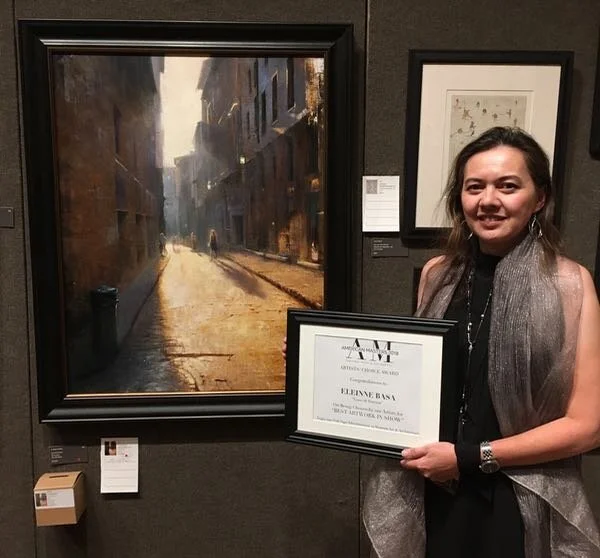
American Tonalist Society founding member Eleinne Basa receives the Artist’s Choice award for her painting “Luce di Firenze” during the American Masters Exhibition and Sale at the Salmagundi Club on Oct. 12, 2018. Western Art and Architecture magazine sponsored the award.
Sojourn en Provence- A Painter’s View
APRIL 12, 2018 – MAY 26, 2018 Sojourn En Provence: A Painter’s View will feature eight modern American plein air painters, including Mary Erickson, Don Demers Eleinne Basa and their voyaging friends at Elder Galleryin Charlotte, North Carolina. A retrospective of the...
APRIL 12, 2018 – MAY 26, 2018
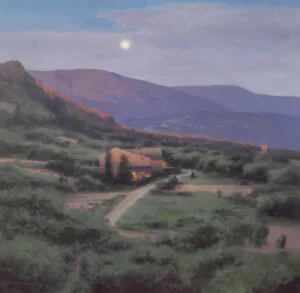
Waning Moon, Rising Sun.
Don Demers
Sojourn En Provence: A Painter’s View will feature eight modern American plein air painters, including Mary Erickson, Don Demers Eleinne Basa and their voyaging friends at Elder Galleryin Charlotte, North Carolina. A retrospective of the group’s work from their travels around Provence, France. Paintings blooming with color, richness and wanderlust.
Welcome
American Tonalist Society (ATS) Founding members / current officers: Pres Eleinne Basa VP Daniel Ambrose Sec Mary Erickson Treas Donald Demers About ATS The American Tonalist Society (ATS) was founded in August 2016, during discussions around the dining room table at...
American Tonalist Society (ATS)
Founding members / current officers:
Pres: Donald Demers
VP: Eleinne Basa, Daniel Ambrose
Sec and Treas: Mary Erickson
About ATS
The American Tonalist Society (ATS) was founded in August 2016, during discussions around the dining room table at Nanatuck, a summer artists’ retreat in Port Clyde, Maine. Prompted by conversations about the current progression of art styles with Don Demers, Mary Erickson and Daniel Ambrose, Eleinne noted through art history the isms, and how they are repeating themselves. We are seeing a resurgence of the tonalist movement now, following the popularity of plein air painting in the 90’s and classical realism in the early part of this century.
The tonalist movement illustrates the departure from emphasis on color, strong contrasts, bravura brushwork, high chroma, and detail. Instead, it focuses on emotion, spirituality, feeling and mood, encompassing luscious, luminous, and vaporous atmospheric effects featuring foggy mornings, evocative moonlit nights with a minimal palette of neutral hues. Like visual poetry, tonalist paintings have a quiet statement of contemplation, mystery, and intrigue.
Mission Statement:
To recognize, promote and showcase the current tonalist movement, and to continue the tradition of the American Tonalists of the 1800s through workshops, exhibitions and catalogues.
The purpose of the painter is simply…to awaken an emotion. – George Inness
Painters of the Early Tonalism Movement
Ralph Albert Blakelock American, 1847-1919 Thomas Wilmer Dewing American, 1851-1938] Robert Swain Gifford American, 1840-1905 Alexander Thomas Harrison American, 1854 -1929 Lowell Birge Harrison American, 1854-1929 George Inness American, 1825-1894 John La Farge American, 1835-1910 Arthur Frank Mathews American, 1860-1945 John Francis Murphy American, 1853-1921 Albert Pinkham Ryder American, 1847-1917 John Henry Twachtman American,1853-1902 Julian Alden Weir American,1852-1919 James Abbott McNeill Whistler American, 1843-1903
Quote by Innes: the goal of a painting is to awaken an emotion…